

Do Not Go Gentle: The Case Against Assisted Death
By: Kathleen Stock
Published: 2026
304 pages
Briefly, what is this book about?
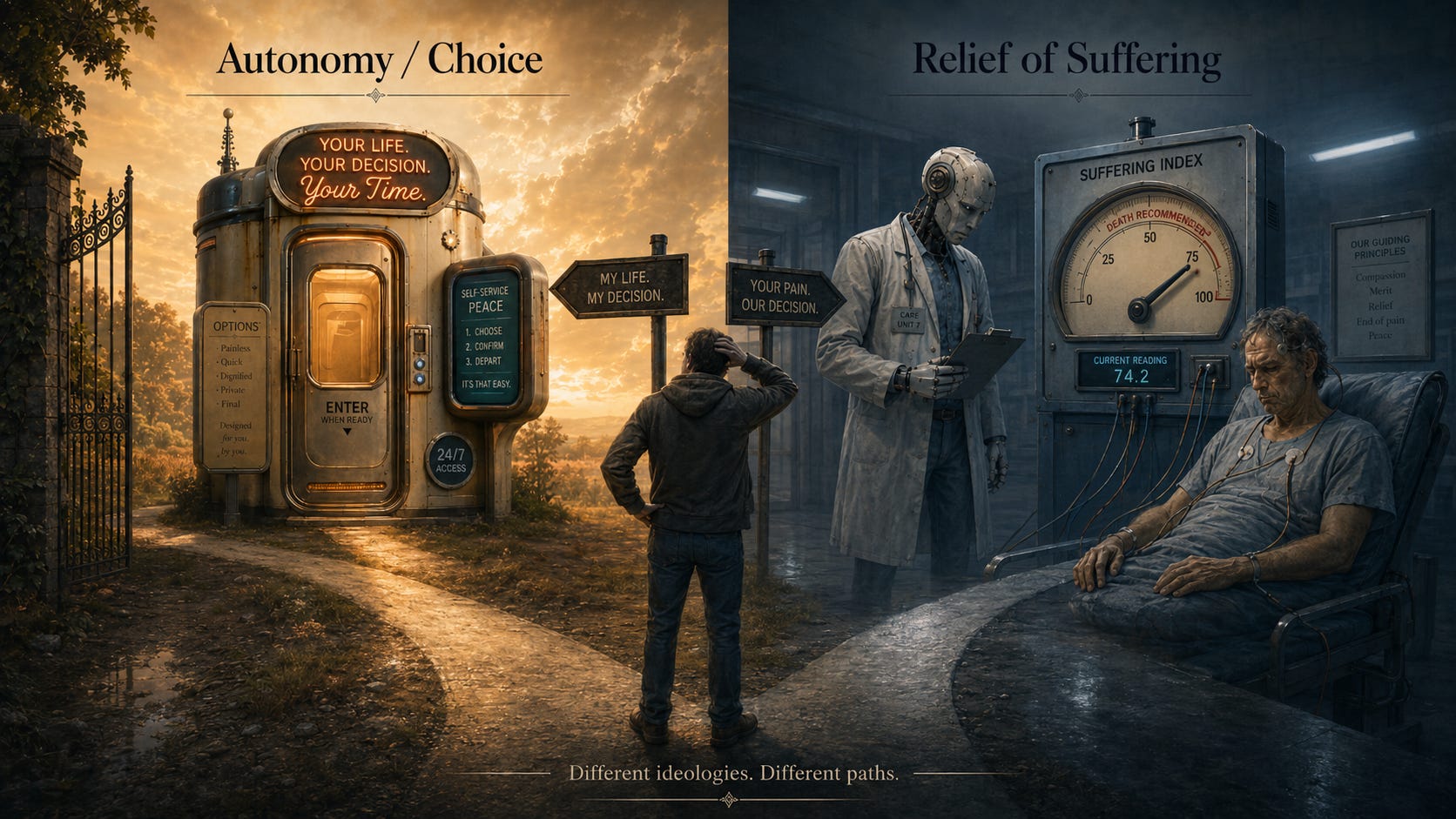
The general topic is right there in the subtitle, but Stock separates out two distinct ideological foundations. There are those who consider assisted death (a term she prefers over “assisted dying”) to be a way of eliminating suffering. And then there are those who view it as a principle of liberty: If we allow people absolute bodily autonomy, why should someone be prevented from choosing to end their life? One problem with having two ideologies is that they might end up pointing in different directions. And indeed one of the big themes of the book is exactly this tension. But the bigger issue is that proponents of assisted death end up using whichever ideological framework is the most convenient for their argument at the time.
When these different ideologies are distilled down to the practice of implementing a legal “right to die”—which is to say actually assisting in the actual death of actual individuals—it results in incoherent standards. This incoherence leads to misinterpretation. The misinterpretation allows for opportunistic expansion. The expansion leads to abuses not foreseen by the law’s framers, and these abuses lead to deaths we might otherwise want to avoid. Some people might call these deaths murders.
What authorial biases should I be aware of?
If you’ve heard of Stock previous to this it was almost certainly for her gender-critical views, which led to her being forced out of her position at the University of Sussex in 2021. I don’t think it’s fair to call her right-wing, but she is definitely iconoclastic.
Who should read this book?
People who want to think deeply about the issue, regardless of the side, would benefit from the book. For those opposed to assisted death, it will sharpen your arguments. For those in favor of assisted death, it will provide the substantial arguments you must eventually contend with.
What does the book have to say about the future?
Stock’s basic forecast is a drift into a situation where more people are dying, and the standards for who qualify become looser and looser. She uses Canada, Belgium, and the Netherlands as warnings, where eligibility has moved from terminal illness to disability, mental suffering, and even to people who are comparatively young.
Her big fear, shared by most opponents of assisted death, is that it becomes a common recommendation for anyone whose life is financially insupportable, overly dependent, unnecessarily humiliating, or just kind of sucky. Her demonstration of the ideologically incoherent nature of the enterprise allows her expression of this fear to carry more weight than most.
Specific thoughts: A little bit of digging reveals a lot of incoherence
The twin ideologies of ending suffering and empowering autonomy act as mottes to the other’s baileys. Consider a hypothetical conversation:
Anti-AD: If autonomy is paramount, you’re recommending the government be required to assist anyone anywhere who wants to commit suicide.
Pro-AD: We’re not recommending a universal right to physician-assisted suicide, we’re only offering it in cases of extreme suffering.
Anti-AD: Where does one draw the line on extreme suffering? Are we putting the state in charge of determining when someone is suffering and whether that suffering is enough? What about anticipated suffering? Do we allow people to die as soon as they can reasonably expect to suffer in the future?
Pro-AD: Of course there would be medical assessments, consultations, and other evaluations.
Anti-AD: And if those assessments were ambiguous and the person really wants to end their life?
Pro-AD: Well, ultimately, we have to respect the person’s autonomy.
*loop back to the beginning*
One of the interesting wrinkles that emerges from this discussion, particularly when we’re considering the value of autonomy and the problem of suffering, is that people are already free to end their suffering whenever they want. Suicide is already an option. They might need help, but they definitely don’t need help so specialized and expensive that we have to pool our resources (i.e. delegate it to the government) in order to pull it off. Yes, assisting a suicide is still a crime in most jurisdictions, but how often is something like that actually prosecuted? This is Stock’s preferred solution. Keep it illegal, but make actual convictions rare.
I’m sympathetic to people who want things spelled out, who think it either needs to be legal and easily accessible, or illegal and strenuously prosecuted. Anything else is hypocritical or incoherent. But both of the maximalist positions have their own problems with incoherence. Suicide has always been difficult to prosecute, often because the person in question is no longer around to prosecute. And, in cases where it was unsuccessful, because of the sympathetic angle. Do you really want to take someone so abject that they attempted to kill themselves, and then throw them in jail? Depending on the circumstances, this often extends to the people who help them. Stock argues that keeping it criminal is a good way of ensuring that people will only do it if it would obviously be the right thing to do, and they’re confident of being acquitted should it come to that.
On the other side, the “legal and easily accessible” position ends up creating a positive “right to die”. As in, not only can we not prevent your death, but the state (and others) are obligated to assist you with your death. Suddenly, rather than staying out of things, we have to create a whole bureaucratic apparatus around killing people, along with laws defining exactly how we’re going to determine who dies. When the government starts implementing laws determining who lives and who dies, it’s hard not to start thinking in dystopian terms, and Stock argues that’s exactly the right framing.
Most people, including Stock, are not claiming that there is never a reason to assist someone with their death. Though for some people you have to go all the way to putting someone out of their misery before they’re burned alive to entirely qualify. But let’s assume that there are some deaths that are genuinely “good deaths”. Might there not also be “bad deaths” under a system of assisted death? It’s hard to imagine that there wouldn’t be some kind of continuum, and at the tail of that continuum, even under a well-designed system (which many of these are not) there would be the rare bad death. Imagine placing every assisted death on this continuum. Somewhere in between “entirely justified” and “horrible mistake” would be a point at which the deaths pass over from good deaths to bad deaths and vice versa.
How sure are we that we’ve drawn that line in the correct place? Or that we’re even capable of drawing it in the right place? When one considers all of the factors that go into making this determination there’s a lot we can never know for sure. If we assume that some deaths are bad, how many of these should we tolerate? At this point probably 100,000 people have died in Canada under MAID since it was first implemented. If even 1% of those deaths were bad deaths—as in it was manslaughter not mercy—then the state has essentially executed 1,000 people. This is institutional killing on a substantial scale. How many “executions” should we tolerate? How “good” do the good deaths have to be to balance things out? Are these even calculations we want to be making? Do we trust the government to implement these calculations? At scale?
Oftentimes, when people are discussing some horrible evil of the past, like slavery, they move on to recognizing that we’re probably in the same position as those earlier generations. We’re probably doing something that future generations will look back on in horror. They might then proceed to imagine what that thing might be. I would offer up assisted death as a strong candidate for future horror.
—-----------------------------------------------------
You may have noticed that my posting has been somewhat less frequent recently. In order to rectify that I’ve come up with a new system. I’ve created an AI agent which monitors my posting. If I don’t complete a post by the deadline then the agent is instructed to explore avenues for assisted death in both Oregon and Canada. Coincidentally, I’m taking a road trip through both states in July.
Should you wish to be updated on how that system is going, and whether death looms, please subscribe. That also helps motivate me.
There's a principle among opponents of the death penalty, better 10 innocent go free than 1 innocent dies. (I think that might be from a court case, but it isn't actually derived from law?)
It doesn't seem to be logic in play by proponents of euthanasia. But I haven't looked into it too closely, maybe there's more reticence than portrayed in conservative media.
There's another irony, though, that this is a liberal issue even as liberal have been becoming less liberal in other directions (or one could say the left is becoming less liberal). Why would bodily autonomy really be presented as some fundamental right at the same time we see ie, England arresting people for social media posts?
I suppose a nuanced argument could be made to thread that needle, but it doesn't seem like it is.
There was a post over on theMotte a year ago (https://www.themotte.org/post/2368/culture-war-roundup-for-the-week/354623?context=8#context) which drew a distinction between Canadian MAID (which he found to have basically slid down the slope into exactly what people feared) and the European programs (which apparently haven't). I'd be interested to hear your thoughts on the matter.