

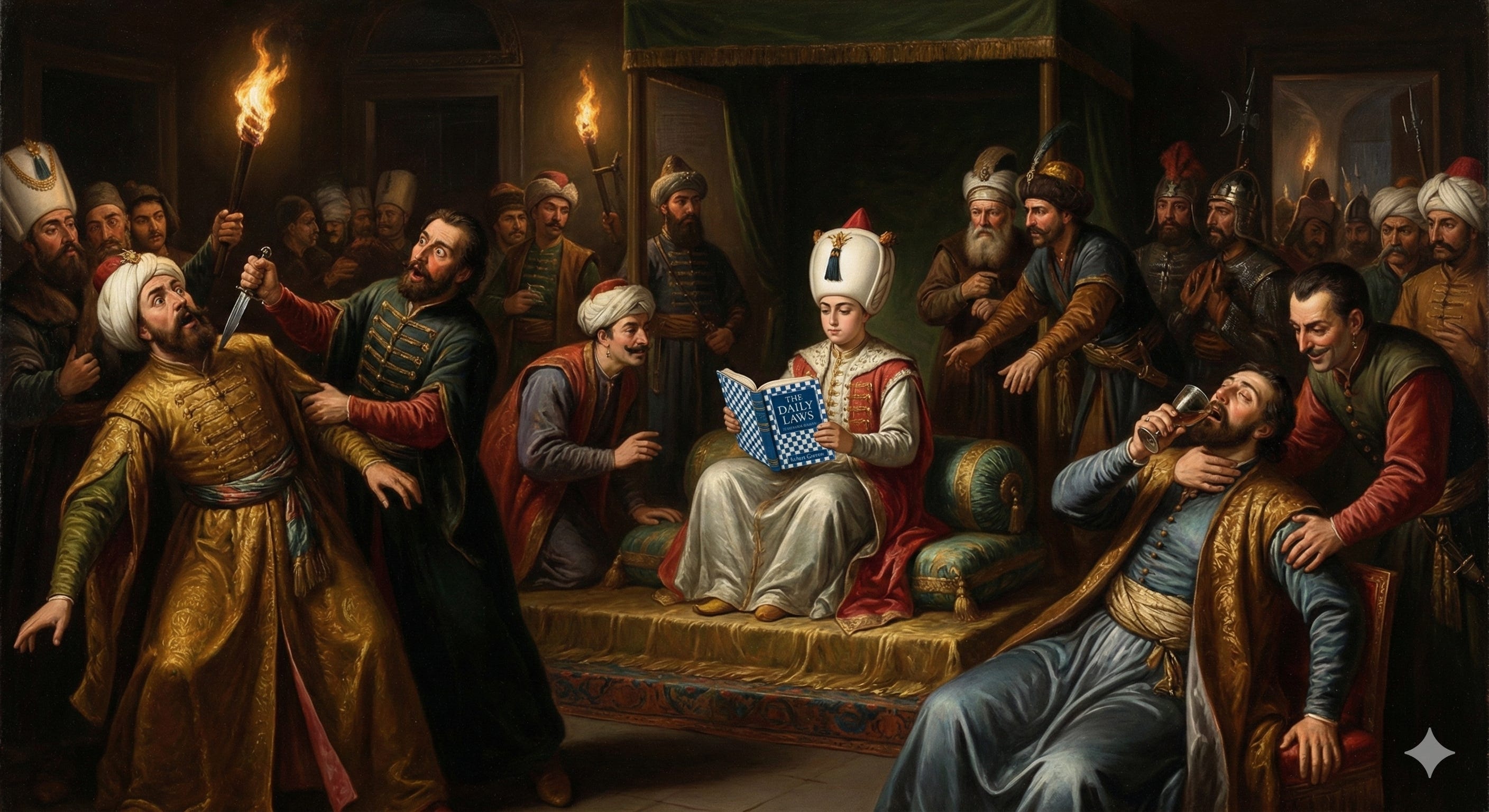
The Daily Laws: 366 Meditations on Power, Seduction, Mastery, Strategy, and Human Nature
By: Robert Greene
Published: 2021
464 Pages
Briefly, what is this book about?
A “page a day” book collecting bits of wisdom from Robert Greene’s other books (Laws of Power, Art of Seduction, Strategies of War, etc.)
What’s the author’s angle?
As a general matter Greene is something of a Machiavellian figure, he’s going to tell it like it is, and give you the tools you really need to succeed in life. Or at least that’s his claim. I generally find his approach to be refreshing, but there are also moments when I would say he takes things too far and dispenses advice that’s counterproductive.
Who should read this book?
If you’re one of the small number of people who likes to have a page of the day book as a way of marking the time from January 1 to December 31, this is an average entry in this very niche genre. But as the genre is not particularly large, any example might be welcome.
If you’ve never done a page a day book I would probably start with Tolstoy’s A Calendar of Wisdom. I thought it was quite good. Also, there’s an argument to be made for it being the first such book chronologically. (It’s the earliest example of a devotional book that wasn’t rigidly sectarian.) Finally, it was banned by the Soviets, which immediately gives it ten extra points in my book.
Specific thoughts: Some good advice, some okay advice and a few pieces of actively bad advice
Let me get this out of the way up front. For obvious reasons I am not quite done with this book, but I thought I’d put out my review so you would have time to buy a page a day book before the new year, should you be so inclined. Also I’m pretty sure there’s not some dramatic conclusion that will change my whole perspective.
Moving on, I’m not sure how I feel about Greene, and this book hasn’t helped. I initially encountered Greene through his book The 33 Strategies of War, which ranks near the top of my favorite non-fiction self-help books of all time. But war is one of those things where being devious and hurtful is expected, so the advice hits differently. Also, at the time I read it, I was in the middle of a horrible work situation where it really felt like war. (You can read that whole story here.) Finally war is just cool, and a book about the great generals of the past is interesting separately from whatever Greene’s moral was supposed to be.
Before I could get around to reading more of Greene’s stuff the horrible work situation exploded in spectacular fashion, and reading about “laws of power” when I was unemployed and fighting a lawsuit seemed vaguely pathetic. Eventually I did pick up The 48 Laws of Power on audio, but it was an abridged version. I have a visceral disgust of abridged books, which was probably compounded by the fact that I was a couple of hours into things before I realized. As such this turned me off again. I have just now discovered that there is a full version (on sale at $2.78 for the next couple of days) so I’ll probably get to it in the next couple of months.
In any case, I’m sure you’re fascinated by my Robert Greene backstory. So fascinated that I will include one more anecdote. I have a friend in prison, and he can only get books from a specific vendor, so when I saw The 33 Strategies of War I decided to order it for him as a gift. It was rejected by the prison, which is when I discovered that Robert Greene is the most banned author in US prisons. I guess people are worried that his Machiavellian advice might actually work.
So what about this book? It’s got some very good advice. For example, from the August 18 page:
A heckler once interrupted Nikita Khrushchev in the middle of a speech in which he was denouncing the crimes of Stalin. “You were a colleague of Stalin’s,” the heckler yelled, “why didn’t you stop him then?” Khrushschev apparently could not see the heckler and barked out, “Who said that?” No hand went up. No one moved a muscle. After a few seconds of tense silence, Khrushchev finally said in a quiet voice, “Now you know why I didn’t stop him.” Instead of just arguing that anyone facing Stalin was afraid, knowing that the slightest sign of rebellion would mean certain death, he had made them feel what it was like to face Stalin—had made them feel the paranoia, the fear of speaking up, the terror of confronting the leader, in this case Khrushchev. The demonstration was visceral and no more argument was necessary. The power of demonstrating is that your opponents do not get defensive, and are therefore more open to persuasion.
Daily Law: Your goal must be to make them literally and physically feel your meaning, rather than pouring words over them.
It has some average advice as well. For example from the October 1 page:
Let’s start with the primary law of human nature. If I had to say what the primary law of human nature is, it is to deny that we have human nature, to deny that we are subject to these forces. We think, I’m not irrational, I’m not aggressive, I don’t feel envy, I am not a narcissist. It’s always the other side. It’s the Republicans, it’s the Spartans, it’s the Ethiopians—they’re the ones who are irrational and aggressive. Me? No. The truth is we all evolved from the same source, from the same small number of people. Our brains are basically the same. We are wired in a similar way. We experience the world, emotionally, the same way that hunter-gatherers experienced the world. Very little has changed in that sense. So if we all come from the same source, why would it be that only a small number of people are aggressive or are irrational? We are all the same.
Daily Law: Accept the nature you share with others. Stop separating yourself out as special or superior.
And finally it has some downright bad advice. For example from April 22:
Doubt is a powerful weapon: Once you let it out of the bag with insidious rumors, your opponents are in a horrible dilemma. On the one hand, they can deny the rumors, even prove that you have slandered them. But a layer of suspicion will remain: Why are they defending themselves so desperately? Maybe the rumor has some truth to it? If, on the other hand, they take the high road and ignore you, the doubts, unrefuted, will be even stronger. If done correctly, the sowing of rumors can so infuriate and unsettle your rivals that in defending themselves they will make numerous mistakes. This is the perfect weapon for those who have no reputation of their own to work from.
Daily Law: Destroy your rivals with rumors.
I suppose if I was vying with my brothers over who became the Sultan, in the Ottoman court of the 16th century, I would definitely want this advice. And I imagine that this advice might also come in handy if I were in prison. But in my current situation I don’t believe I would ever follow that advice, unless lives were at stake or something similar.
In the end I would recommend the practice of having a page a day book. It’s a nice way to start or end the day. However, I would only weakly recommend this particular page a day book. Instead have already recommended Tolstoy. I also liked Ryan Holliday’s Daily Stoic. (Holliday is actually a protege of Greene’s.) And in 2026 I’ve decided to pick up The Daily Pressfield which I expect to be quite good. But given the format it may be months before I know for sure
Tune back next year at this time to find out what I thought of the dailyness of Pressfield, but if you can’t wait you’re welcome to grab your own copy and follow along. I don’t know that there will be any benefit to doing so, but if you decide to do it at least let me know. Perhaps it will become a thing. A daily connection across the miles. Or you can settle for the 2-4 times a week connection of just subscribing.
Your Robert Greene backstory made me realize that I am myself embroiled in a battle of wills with a local barista (don't ask, it's so asinine), and could stand to sharpen my war skills. Purchased!
One daily devotional (in the category of page a day book?) that is interesting and beautifully written is Ramon Llull's The Book of the Lover and the Beloved, which is available for free online. He was a medieval friar who was a missionary to Muslims in North Africa and was influenced by Sufism in his devotional.