

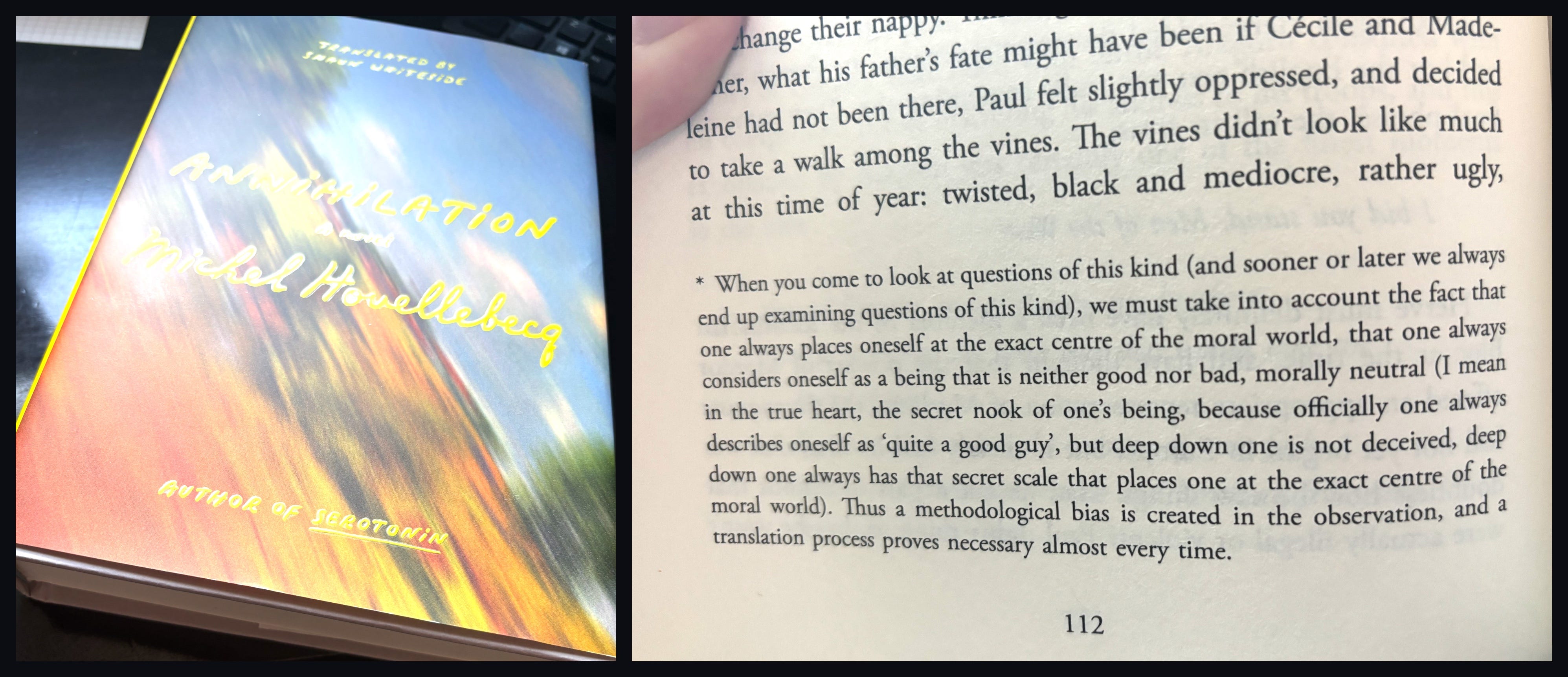
Translated by: Shaun Whiteside
Published: 2022 (English translation 2024)
544 Pages
Briefly, what is this book about?
Houellebecq is a well-known French author, and this book felt very French to me. What does that mean? Good question… Certainly there is a lot of wine drinking, a fair number of R-rated sex scenes, and French politics plays a major part as well. Mostly I think there’s a lushness, and a lack of action or even conclusion, which reads more as European decadence than the typical American delusion I’m used to.
I opened with a description of the atmosphere because this is a very atmospheric book. Though initially it pretends to be a techno-political thriller, don’t be deceived; this book is a melancholic reflection on aging, ennui, death, and loneliness. The central character is Paul Raison, a high-level French civil servant, who appears to have it all, but actually has nothing. The hollowness of his life is brought home when his father has a stroke. This serves as a catalyst for recognizing his emptiness and attempting to pull together some meaning. In particular, it helps thaw the long frozen relationship with his wife.
To the extent that he finds meaning, it’s always found in small things, relationships, meals, conversations. And this greater sense of connection doesn’t solve all of his problems. In fact, re-engaging with his wife, the world, his family, and his father, brings a whole host of new problems. The journey ends up being very bumpy, but more satisfying than his previous hollowness.
What authorial biases should I be aware of?
Houellebecq clearly has a reactionary bent. The book is full of nostalgia for traditions, suspicion of modern bureaucratic democracy, and a large dose of fatalism about the current state of the world.
Despite the fact that Houellebecq is a self-declared atheist, the book depicts Paul’s devoutly Catholic sister as having the better life. When Paul’s father is put into a care facility after the stroke this gives Houellebecq the opportunity to offer up an extended subplot on the failures of end-of-life care along with a pessimistic take on assisted suicide.
All of which is to say that Houellebecq is not shy about taking a political stand as part of his fiction.
Who should read this book?
The characters and the prose were both great. On the other hand, the various plots introduced were all left without a conclusion, and generally in a very frustrating fashion. So if you’re the kind of person who just enjoys good writing, you might like this book. But if you like your plots to go somewhere, I would avoid it.
What does the book have to say about the future?
This book imagines that France is able to turn its economy around through an industrial revival. Materially, things are going better than people expect. Spiritually, the country is suffering annihilation, as per the title of the book. Which leads to…
Specific thoughts: Is this book best thought of as a biography of Nietzsche/Fukuyama’s “Last Man”?
At some point while I was reading this book, I flipped to framing Paul Raison as being the “Last Man”. This framing definitely improved the book and turned some of the abandoned plot points into deep reflections on meaninglessness. (Or at least it added that as one potential interpretation.)
I’m not an expert on the concept of the Last Man, and I’m mostly familiar with it from Francis Fukuyama’s book The End of History and the Last Man (see my review here), rather than Nietzsche. But as I understand it, the Last Man is a person who exists after the struggle and the glory of the world have passed. He has no transcendent beliefs, engages in no heroic struggles, and has no appetite for greatness. The Last Man is all about stability, comfort, and safety. His desires are modest: diverting entertainment, constant low-intensity pleasure, and a lack of worry or struggle. Both Nietzsche and Fukuyama argue that we can’t live this way (the former more than the latter) and that eventually struggle and conflict will return.
Fukuyama worries that we have arrived at a place without meaning. That we lack drive, or thymos, as he calls it. Market-based liberal democracy has given us material comfort but removed the struggle that previously propelled history. His worry is that unless we can figure out how to restore thymos as part of our modern affluence, history will violently reassert itself in the form of wars and revolutions and generalized upheaval. Paul definitely lacks thymos at the beginning of the book, and if this were an American book, he would receive a call to adventure, and his life would gain meaning from rescuing a kidnapped child, or fighting off the local mob, or maybe just pushing through funding for a new school.
But this is not an American novel; it’s a French one, so Paul finds meaning in confronting death, first his father’s and then his own. And also, through rekindling his sexual relationship with his previously estranged wife. And I mean really rekindling…
Perhaps this distinction is how one makes sense of the techno-political thriller part of the book. The book doesn’t open with Paul at all. The first character we’re introduced to is Bastien Doutremont, a government analyst with the DGSI (France’s version of the FBI) who’s trying to track down some terrorists. The terrorists have been releasing flawless CGI videos. (One of the first depicts Paul’s boss, the one responsible for France’s industrial renewal, getting guillotined.) Later on the terrorists get more ambitious and start attacking cargo ships and a sperm bank. About 80% of the way through the book, they figure out that the attacks form sort of a pentagram, which reveals the final attack. The book has a big two-page spread showing the map and the pentagram, and then that entire subplot is never mentioned again.
I guess I should have warned people about spoilers, but in a sense it’s an anti-spoiler. There is nothing to spoil. There is no twist. There is no dramatic ending where all is revealed. It’s as if Houellebecq is saying, “You imagine that your hollowness will be filled by some dramatic world-historical event. Grandeur and glory will return in some interesting way, and you’ll be at the center of it. But in a cool way, not a scary way. Instead, like Paul, you’re eventually going to get old and die, and the only salvation in that moment will be having people who love you.”
Yes, this is an oversimplification of a complex and frustrating book. But it’s a simplification I quite like. And if, five years from now, this is all I remember about the book (and that only after I re-read this review to remind me) I will still be glad I read it.
—----------------------------------------------------
I’m wondering if I should get a copy of this book in the original French. I do like having books in the original language. One time I was in Montreal, and I decided to pick up a copy of Les Miserables. Somehow I had picked up enough French to check out, so I decided to try it out. I was not prepared for a long return question also in French. I had to admit I didn’t really speak French. At this point the cashier looked at the books, which were in French, then to me, who had just spoken some French. Then back to the books. He repeated this several times, clearly very confused, before finally asking for my credit card in English.
Think of how many substacks you subscribe to that haven’t told a funny story like that. And you haven’t subscribed to mine?!? (Or most likely you have, but I’m talking to the few who haven’t.) What are you waiting for?
"But if you like your plots to go somewhere, I would avoid it." So... probably not my cup of tea. Out of curiosity, what did you think of Submission?
I bought the Last Man framing as soon as you got to the pentagram map that never cashes out. In an American novel that would be the engine of the third act; here it just proves Paul is not being saved by history, only dropped back into his father’s decline and his own marriage.