

A Primer for Forgetting: Getting Past the Past
By: Lewis Hyde
Published: 2019
384 Pages
Briefly, what is this book about?
The necessity of forgetting, as conveyed through a broad collection of stories, essays, quotes, reflections, etc. It’s more atmospheric than prescriptive.
What’s the author’s angle?
This is an important writer, doing important writing, lauded as important by other writers, teaching at an important university (for a time Harvard). None of this is necessarily bad, and it can be quite good, but you should know what you’re in for.
Who should read this book?
David Foster Wallace (who I greatly admire) called Hyde “One of our true superstars of nonfiction” though he can’t have been talking about this book since it was published long after he was dead. If his statement or anything in the last section piques your interest, then perhaps you will enjoy this book. I’m sorry I can’t be more specific. It’s that kind of book.
Specific thoughts: An attempt to eat his cake and have it.
I found this book to be very uneven. There are parts of it I very much enjoyed. The eclectic form appealed to me as well. Finally I basically agree with his message. It reminds me of one of my favorite quotes from Aldous Huxley:
Chronic remorse, as all the moralists are agreed, is a most undesirable sentiment. If you have behaved badly, repent, make what amends you can and address yourself to the task of behaving better next time. On no account brood over your wrongdoing. Rolling in the muck is not the best way of getting clean.
It would be nice if I could leave it there, but I can’t. In addition to all the stuff I enjoyed, the book had one serious issue. You might say it either went too far, or didn’t go far enough.
Forgetting, especially to the extent that it translates into forgiving, is great advice for individuals. And if the book had limited itself to individual advice I would have been very complimentary. But Hyde decides to go father and discusses forgetting at the level of nations. It’s one thing to say that I should forgive a junior high bully. Or that a child should forgive their abusive father. Or even that Erika Kirk should forgive her husband’s murderer. It’s another thing to say that black South Africans should forgive white South Africans for apartheid. Or that the Ukrainians should forgive the Russians. Or that the Palestinians should forgive the IDF.
But should it be?
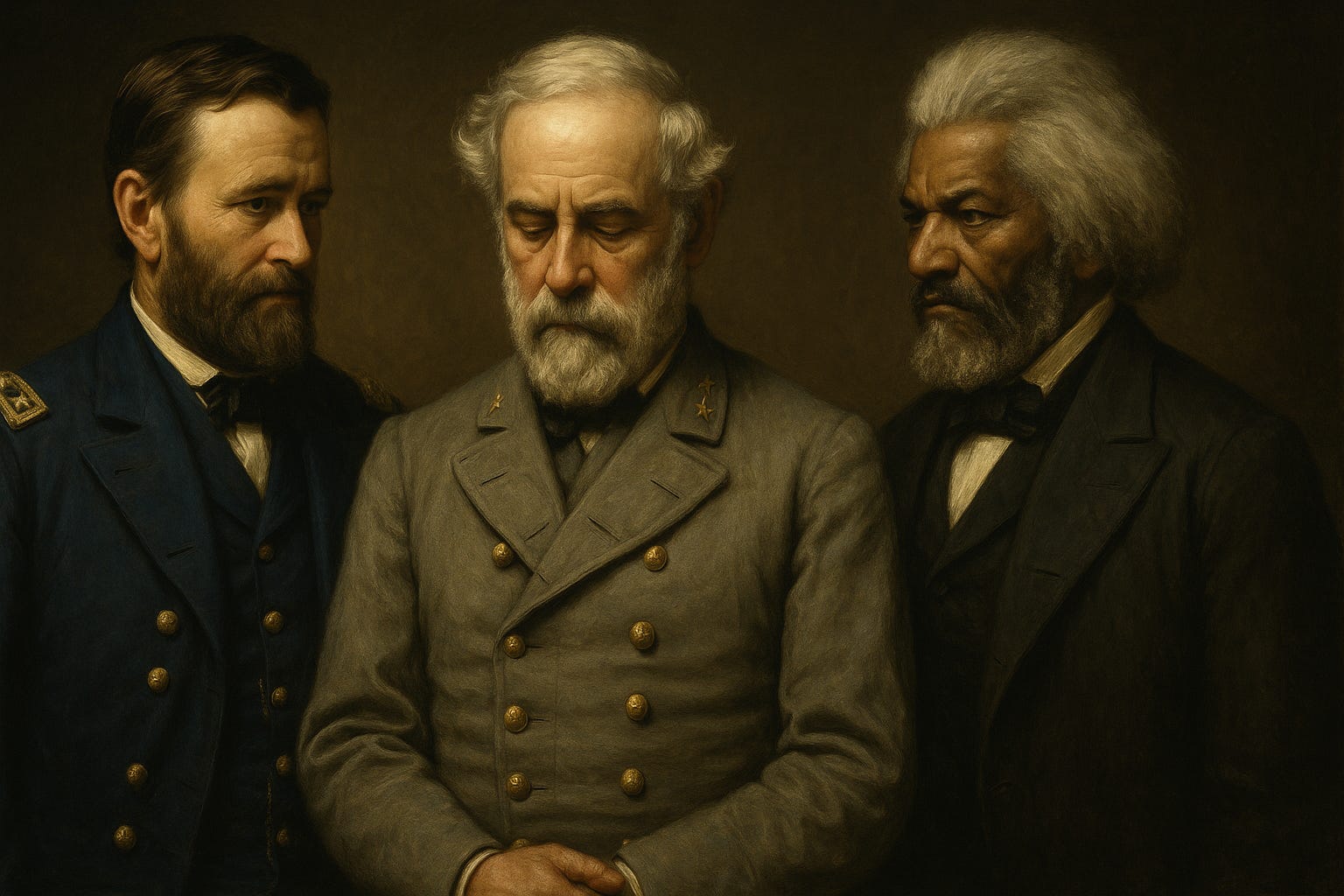
Certainly the south wanted to forget the Civil War. Consider this passage from the book describing Robert E. Lee’s attitude in 1869:
Declining an invitation to a Gettysburg memorial, Lee declared it “wiser … not to keep open the sores of war, but to follow the examples of those nations who endeavored to obliterate the marks of civil strife and commit to oblivion the feelings it engendered.”
But, as you might imagine, not everyone felt that way. Consider Frederick Douglass:
Douglass’s speeches always call for remembrance and dispute the Lost Cause narrative point by point. Disgusted by the “hand clasping across the bloody chasm business,” Douglass called out all who, “in the name of patriotism,” ask us “to remember with equal admiration those who struck at the nation’s life, and those who struck to save it—those who fought for slavery and those who fought for liberty and justice.” Union and Confederacy were not each correct and honorable in their own way. “May my tongue cleave to the roof of my mouth if I forget the difference between the parties to that … bloody conflict.”
Certainly nearly everyone understands and is sympathetic to Douglass’ argument. But doesn’t this seriously undermine Hyde’s argument? Isn’t this, on some level, a fatal blow?
Hyde had three choices:
He could have declared that nations were different, or easier yet, ignored forgetting at that level entirely.
He could have pushed his premise to its logical conclusion and said that, however much we admire Douglass, he was wrong. And he should have forgiven and forgotten.
Or he could come up with some framework to distinguish individual forgetting from group forgetting.
As you can probably guess he chose the last option. And this was my major problem with the book. The framework seemed vague and somewhat contradictory. His framework leans heavily on an element of accountability which seemed to be saying, “Before you can forget you have to remember really hard.”
Most frustratingly, he seemed to have very little to say about the current moment. The late 2010’s, when the book was written, was in desperate need of advice on how to move past things. And not only did he have none, I’m not sure that I could have extrapolated a recommended course of action from what he did say. At many times you thought he was saying one thing, but then at other times he seemed to be saying it’s opposite.
So what would I do? As you may know I’m a member of The Church of Jesus Christ of Latter-day Saints. You probably heard about the terrible incident in Grand Blanc, where a man ran his truck into an LDS church and then set it on fire. You have probably also heard that one of the members of my church started a fund-raising campaign for the family of this man. As of this moment it has raised $383,525. I don’t know if that’s forgetting, forgiving, or something beyond both (pure charity?) But that’s the sort of thing I’m recommending during this troubled time. Let’s have more of that.
If I’m going to take some of my own advice, I have probably been too hard on Hyde. In the end he’s trying to help heal the nation. We should all be doing the same. The nation needs all the help it can get.
I’m reading Ron Chernow’s biography of Ulysses S. Grant (review coming shortly) and it is amazing to compare the animus which existed at the time around these issues, to the animus that exists now. We seem to have done the opposite of forgetting. But perhaps I’m painting with too broad a brush. I have a tendency to do that. I’m a big picture kind of guy. I leave the details to others. If hasty generalizations, and vague observations appeal to you, consider subscribing, or if you’re already subscribed consider reading.
"my church started a fund-raising campaign for the family of this man. As of this moment it has raised $383,525. I don’t know if that’s forgetting, forgiving, or something beyond both (pure charity?) But that’s the sort of thing I’m recommending during this troubled time. Let’s have more of that."
I do applaud the attempt at reconciliation, but I am a little unsettled at the possibility of perverse incentives. No, half a million isn't enough life insurance for me to go out like that even setting aside the evil of it, but when we've manifestly got marginally sane and desperate people? I worry.
My first inclination to whether national forgiveness/forgetting is right (and I think forgetting is meant in the sense of not picking at scabs, rather than literal blotting out from history books) is if the lesson is learned. Should we forget slavery and Jim Crow? I do tend to think that collectively white or southern America or whomever one wants to blame has moved on from racial division, occasional civil war monument aside.
Should we, say, forget Covid lockdowns? I don't think we can even agree on which side was wrong at this point. We should probably continue the conversation about when and for how long lock-downs were justified before, but I think most people just want to put that behind them. All well and good, unless there's another such event and we find we've not only learned nothing, we still have the old wounds unhealed.